
One of the many blessings of the industrial revolutions is, it has led to the birth of technology. Technology has allowed us to work remotely, reduce commuting time and attract a wider talent pool. However, it has also created a cycle where it is hard for us to switch off. The rule of thumb when working from home is one needs to be reachable during work hours which means one needs to pick up calls, answer emails at a stipulated time and rely on instant messaging. These were once confined within the office space but are now shifting over to our homes. It begs the question, does remote working enable us to adopt a work-life balance or is it just moving work from one premise to another?
More often than not, one feels extremely anxious and overwhelmed because of the outpouring digital notifications that need immediate attention. One can argue that messages and/or emails can be ignored if one chooses to do so, but the sense of obligation may make it difficult for some to do so. Consequently, the temptation to quickly respond to instant messages and emails becomes stronger that one cannot disconnect. It is not surprising that many are stuck in the replay mode when working from home due to failure to disconnect after work hours. It is undeniable that technology is fundamental, especially in maintaining connectivity with a remote workforce. Technology is the main thing that has made remote working possible.
As everyone does not need to commute anymore, a new normal has been established – conducting lots of virtual meetings to check in on one another and ensure that work is being done.
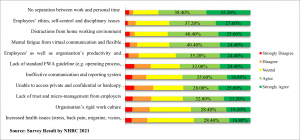
Introducing virtual meetings for daily check-ins and for the purpose of monitoring performance and fostering communication seem to be the measures taken by most employers. Hence, it comes as no surprise that meetings are now conducted more often than before. Reportedly, 40% of remote workers experienced mental fatigue from virtual communication based on a survey conducted by the National Human Resource Centre (NHRC) in 2021. Meetings which were once perceived as one of the most inefficient elements of a traditional office has now been amplified and shifted to the remote work setting. When one is kept busy with virtual meetings, one’s real work only gets done later in the day and sometimes after work hours. This sets an unhealthy lifestyle for employees who will need to work overtime and respond after work hours.
Social bonds at the workplace are created by expressing verbal and non-verbal communication through small talks about work and life, which virtual meetings cannot replace or replicate. Furthermore, trust is harder to build through virtual meetings, instant messaging and emails, as the limitations on these platforms such as missing social cues, poor internet connectivity and distractions from the home environment can cause annoyance between team members or breed misunderstandings.
An article by BBC titled; ‘Why remote work has eroded trust among colleagues’, revealed that trust between remote employer and employee is eroding due to the lack of in-person interactions. It is likely for one to make unfounded assumptions of the other, causing remote managers to over-monitor the employee through virtual meetings as a substitute for in-person human interactions. The lack of trust is reportedly more noticeable during home-based working with around 32% of employers agreeing to this according to a survey conducted by NHRC. This causes psychological distress to both employers and employees which can harm their relationship as well as performance.
Psychological effects of working from home
The social aspect of work such as the small talks and rants about work and life is missing in remote working. It is different for one to chat up with colleagues using instant messaging than in-person human interaction where emotions are exchanged and expressions are easily read. This disconnectivity from colleagues and the rest of the world makes one feels lonely and isolated. Traditional work office has provided the space for one to socialise and maintain a clear work-life divide. In a remote working environment, this divide has beenincreasingly blurred. Unlike most working adults, young working adults are more likely to suffer from loneliness than the rest because they mostly live alone, which means being more isolated and unable to interact with others. When Facebook’s founder Mark Zuckerberg announced that all employees will be working from home by 2030, only one in five employees were enthusiastic about it. The reason being young adults need human connections at the workplace to maintain their sanity.
As the boundary between work and life is blurred, one may feel pressured to be on when one should be off. This is unsurprising when work is in the same place as one sleeps. The compulsion to be on 24/7 stems from wanting to be the best and devoting everything to work since every aspect of life is diminishing as the pandemic continues for a prolonged period of time. As a result, people often experience burnout where they start neglecting their own well-being, becoming less enthusiastic about work, and relationships with friends and family become less important. Burnout is a cyclic phase and will take a psychological toll on physical and mental health such as sleep disruption, as well as increased or decreased appetite. Anxiety, stress and loneliness can lead to depression.,It is not just feeling down but also the feeling of riding a roller-coaster of emotions as if one could not control their emotions anymore. When one is depressed, one may feel demotivated and stuck with little to no career progression, unlike working in the office. It is noteworthy to mention that career progression can mean acknowledgement and praises from the managers and these are often missing in a virtual environment. Instead, trust issues and poor performance is often enhanced when working from home.
Knowing the effects, dealing with it
Understanding and observing the psychological effects when working from home can help manage one’s expectations. Since burning out does not happen overnight instead it is an accumulation of events, one must know one’s limit. In doing so, one must redefine boundaries, rethink priorities and set their own threshold levels. Reorganising schedules such as break time, outlining tasks for the day, having a proper meal and keeping an active lifestyle can help in sustainable recovery from chronic stress, unwarranted pressure and ultimately reducing the occurrence of depression.
However, identifying and mitigating psychological effects should not be on employees’ shoulders alone, it should also be a top-down approach. It is essential to note that overworking is often behavioural and cultural rather than lack of organisation’s policy on the matter. Perhaps managers can set their employees’ expectations, reduce long hours of virtual meetings and encourage rest time for employees. Additionally, managers should also be aware of time, for instance; managers should think about the necessity of sending messages or emails after work hours because each time a device pings, it will enhance anxiety. This may be one of the best practices that could be adopted by organisations to create a healthy working culture.
As taking care of mental health is equally as important to our physical health, we need to be realistic of what we can and cannot do as well as what we should and shouldn’t do. No doubt, without technology, the hybrid way of working is impossible but this should not be at the expense of our mental health.
Sam Pei Ying is part of the National Human Resource Centre’s (NHRC) Policy Development team. Her current role at the NHRC involves carrying out policy research at the national level.
