

Professional certifications are a reliable way to validate skills and knowledge, benefiting both professionals and organizations.
A Professional certification is a third-party attestation that an individual (or organization) has demonstrated competence against defined standards-distinct from a license (a legal authorisation) and from accreditation (evaluation of the certifying or assessing body). Globally, person-certification bodies are guided by ISO/IEC 17024, which specifies principles for developing and maintaining a certification scheme, impartiality, and competence requirements for the certifying body. (ISO)
For organizational certifications and management system standards, two adjacent frameworks apply: ISO/IEC 17021-1 for bodies that audit and certify management systems (e.g., ISO 9001, ISO 27001), and ISO/IEC 17065 for bodies certifying products, processes, or services. These standards ensure consistency, impartiality, and competence across certification bodies and are underpinned by the International Accreditation Forum’s Multilateral Recognition Arrangement (IAF MLA), which promotes mutual recognition of accredited certificates across borders. (ISO, IAF)
Within Malaysia, HRD Corp’s quality architecture (e.g., HRD-TDF) sets a national baseline for training standards and trainer competence – an important policy lever to ensure funded learning pathways align with workforce needs. (HRD Corp)
Certification is the formal attestation or confirmation of certain characteristics of an object, person, or organization. This confirmation is often, but not always, provided by some form of external review, education, assessment, or audit. Accreditation is a specific organization’s process of certification
Certification can be seen as a form of communication along the supply chain. The certificate demonstrates to the buyer that the supplier complies with certain standards, which might be more convincing than if the supplier itself provided the assurance. A third party gives written assurance that a product, process or service is in conformity with certain standards; it is critical to establish the right body performing it.
The organization performing the certification is called a certification body or certifier. The certification body would perform actual inspections and the certification decision, i.e. the granting of the written assurance or “certificate”.
For working adults, certifications signal competence and portability across employers. In the United States, where the labour force is closely tracked, 24% of employed workers held a certification or license in 2024; those with credentials are consistently concentrated in higher-skill occupations, and historical series indicate earnings and employability benefits relative to non-credentialed peers. While country effects vary, these data points illustrate the economic logic behind credible certification. (Bureau of Labor Statistics)
For employers, certifications reduce hiring risk, accelerate time-to-competence, and support compliance in safety-critical or regulated roles. When certifications are outcome-based and externally validated (e.g., by NCCA-accredited programs or ISO-aligned schemes), they also support international mobility and vendor assurance in cross-border value chains. (Credentialing Excellence)
For policymakers, certifications are a scalable lever for workforce transition. The World Economic Forum projects large-scale skill disruption through 2027, with reskilling and credentialing among top corporate responses—underlining the need to standardize and signal skills at speed. (World Economic Forum, World Economic Forum)
It is critical that professional certifications validate expertise in a specific field, role, or technology. In order to demonstrate proficiency, candidates are required to pass exams or complete programs to prove their knowledge and skills to employers.
In order to obtain industry recognition, it is paramount to earn a certification to demonstrate to employers and clients that you have a recognized level of competence in your profession. On career advancement, it has been inevitable that certifications can provide a competitive edge, open doors to new opportunities, and meet requirements for certain roles.
Certification as a complement to education
Professional certification is not a replacement for accredited degree work but instead is supposed to complement your education or professional experience in your field. Once you’ve earned a certification, you are given a designation that you can use after your name as a way to distinguish certified professionals from their uncertified peers. To keep your certification, the administering organization will ask for proof that you’ve obtained the required continuing education periodically (typically one to five years, depending on the certification) before you are allowed to renew your certification.
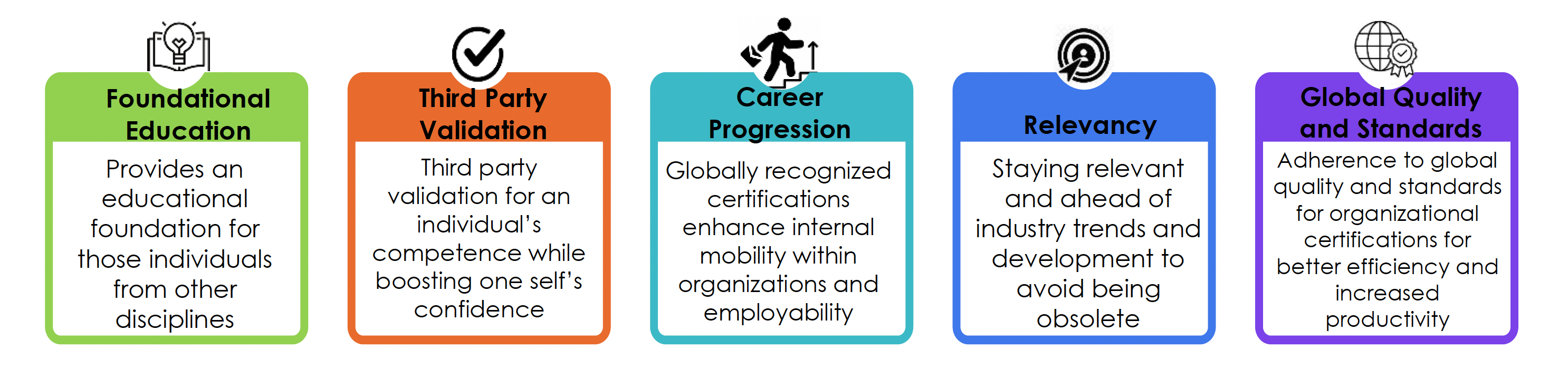
i. Individual Certifications
Purpose
Validates an individual’s knowledge, skills, and adherence to specific standards within a particular field. It serves as a credential that demonstrates competence in that field.
A certification essentially consists of three (3) Es’ i.e. specific work experience, education and examination to assess the level of competency. To determine specific certification programs, the work experience required should be at a professional level, rather than merely the number of years of work experience.
Benefits
ii. Organizational Certifications:
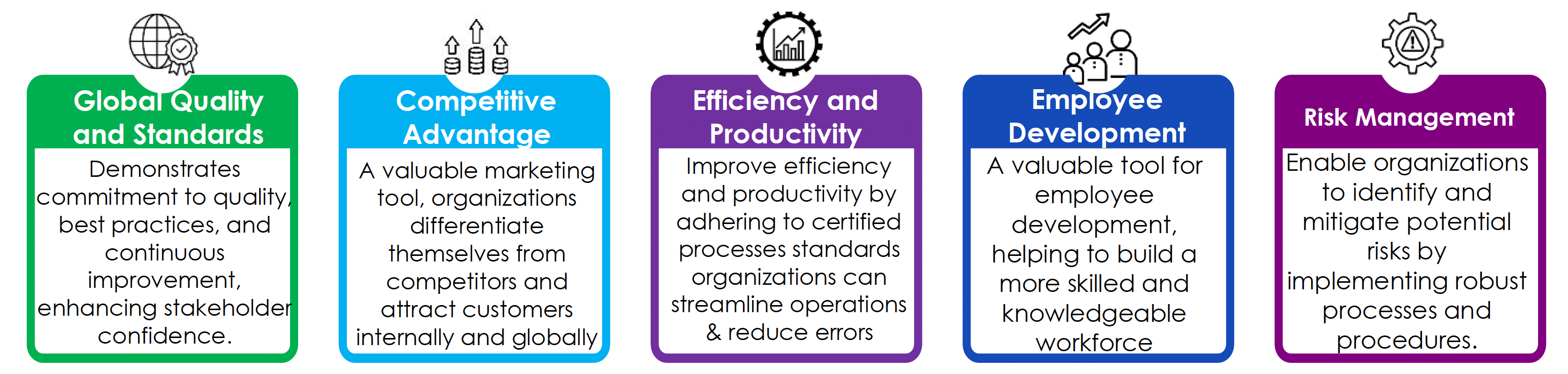
Purpose
Validates an organization’s adherence to specific standards within a particular field. It serves as a credential that demonstrates competence in that field.
Benefits
Certification Landscape: Three types of Professional Certifications, One Goal.
These certifications validate skills and knowledge and are often required for certain jobs or to enhance career advancement.
Building on the Braintrust content, certifications cluster into three archetypes:
i. Corporate/Internal Certification
Internal certifications created by a corporation for certification purposes within that company are generally not portable to other corporations. Developed and administered by specific companies for their employees, focused on internal processes, products, or systems unique to that company.
This would include a company’s sales team training course. Upon completion, employees receive a certificate, but it holds little value outside the company.
Examples of corporate certifications include:
These certifications, otherwise known as role-specific certifications, are specific to certain products and are intended to be carried with the holder across companies that use that specific product. This type of certification is common in inbound marketing and information technology (IT) industries, where professionals are certified to work with certain software or hardware products
Focuses on a particular product or technology, often offered by the manufacturer. Recognized across different organizations that utilize the same products. Demonstrates proficiency in specific software/hardware, which enables product certifications to travel within ecosystems (e.g., platform vendors).
Examples of product-specific certifications include:
The broadest type of certification is profession-wide, a type of certification that is portable to wherever the certified professional may work. Widely recognized and accepted across an entire profession or industry. Rigorous exams and requirements, demonstrating a high level of expertise and competency. Often associated with career advancement and professional credibility. 10
In general, professional certifications include functional credentials certifications such as project management, cybersecurity, finance, and HR. Profession-wide carries the widest external recognition—especially when backed by rigorous standards and accreditation.
Specific examples of profession-wide certifications include:

A case in point is HRCI’s global HR professional credentials (aPHRi, PHRi, SPHRi, GPHR, etc.), which are positioned as globally portable and the only global certification body to be further accredited by NCCA. HRCI has more than 500,000 certification holders across 125+ countries and an adoption among over 95% of Fortune 500 employers – indicating strong market signalling power when psychometric and governance requirements are met. (HRCI Marketing)
Focus on Standard-Based Assessment
Focuses on assessing and validating an individual’s skills and knowledge against specific, predetermined standards rather than simply evaluating time spent in training or traditional academic measures.
Emphasis on Practical Mastery
This approach emphasizes practical application and mastery of competencies, often incorporating real-world scenarios and performance-based assessments.
Principle: Certify what learners can do, not just what they have attended.
Designing a Competency-Based Certification Model
8 Core steps (end-to-end) include:
i. Define the standard: Identify the competencies
Conduct a defensible Job/Practice Analysis to surface domains, tasks, knowledge/skills/behaviours/abilities (KSAs), and performance contexts. NCCA Standard 14 requires job analysis with sound psychometrics (SME panels, validation surveys, representativeness) to ensure content validity. (Credentialing Excellence, dodcertpmo.defense.gov)
ii. Blueprint & outcomes:
Translate the analysis into a test blueprint and observable learning outcomes (LOs). Align cognitive complexity (e.g., recall, application, analysis) with item formats (MCQ, scenario-based, performance tasks). Guidance derives from the Standards for Educational and Psychological Testing (AERA/APA/NCME). (AERA, The Standards for Testing)
iii. Assessment Design: Develop Assessments
Create assessments that accurately measure an individual’s ability to demonstrate those competencies. Many of these competencies are closely linked to professional-level experience. Develop items and performance assessments following documented item-writing guidelines, content reviews, bias/fairness checks, and pilot testing.
Use a standard setting method (e.g., modified Angoff, Bookmark) to derive a passing score consistent with NCCA Standard 17. (ARRT Volunteer Portal)
iv. Delivery & security
Select delivery modes (test centres, remote proctoring) with identity verification and incident management. Maintain item banks, exposure controls, and continuous data forensics.
v. Preparation Pathway: Role of CPPs
Curate but keep at an arm’s length – Certification Preparation Providers (CPPs). As the Braintrust deck notes, CPPs may offer ≥ 40 hours of preparatory sessions led by certified facilitators who are also the subject matter experts (SMEs). They are also required to be certified themselves in addition to being certified as HRD Corp Accredited Trainers.
Most preparatory sessions for functional programs such as IT, HR, Tech or Finance, the prep sessions should involve sharing of professional-level experiences in relation to the content of the programs.
vi. Assessment of Competencies via Exams
Evaluate the individual’s performance against the established standards via exam and practice exams on the learning platform. However, the respective certification bodies must retain independent exam control to avoid conflicts of interest. This can be done by partnering with independent companies administering computer-based exams for professionals, licensing and academic admissions. They provide secure
testing services through a worldwide network of physical test centres and online proctoring.
vii. Granting of Certification: Governance & Quality Assurance
Establish an independent certification committee; enforce conflict-of-interest policies; run annual technical reports (reliability, item stats, form equivalence). A minimum passing score of 70% is required for the successful granting of certification.
Recertification/CPD:
Require periodic renewal (e.g., every 3 to 5 years for individual certification and 3 to 5 years for certain organizational certifications such as ISO) via credits or re-examination to ensure currency with up-to-date practices, continued competence and alignment with evolving industry standards.
Benefits of Adhering to a Competency Framework
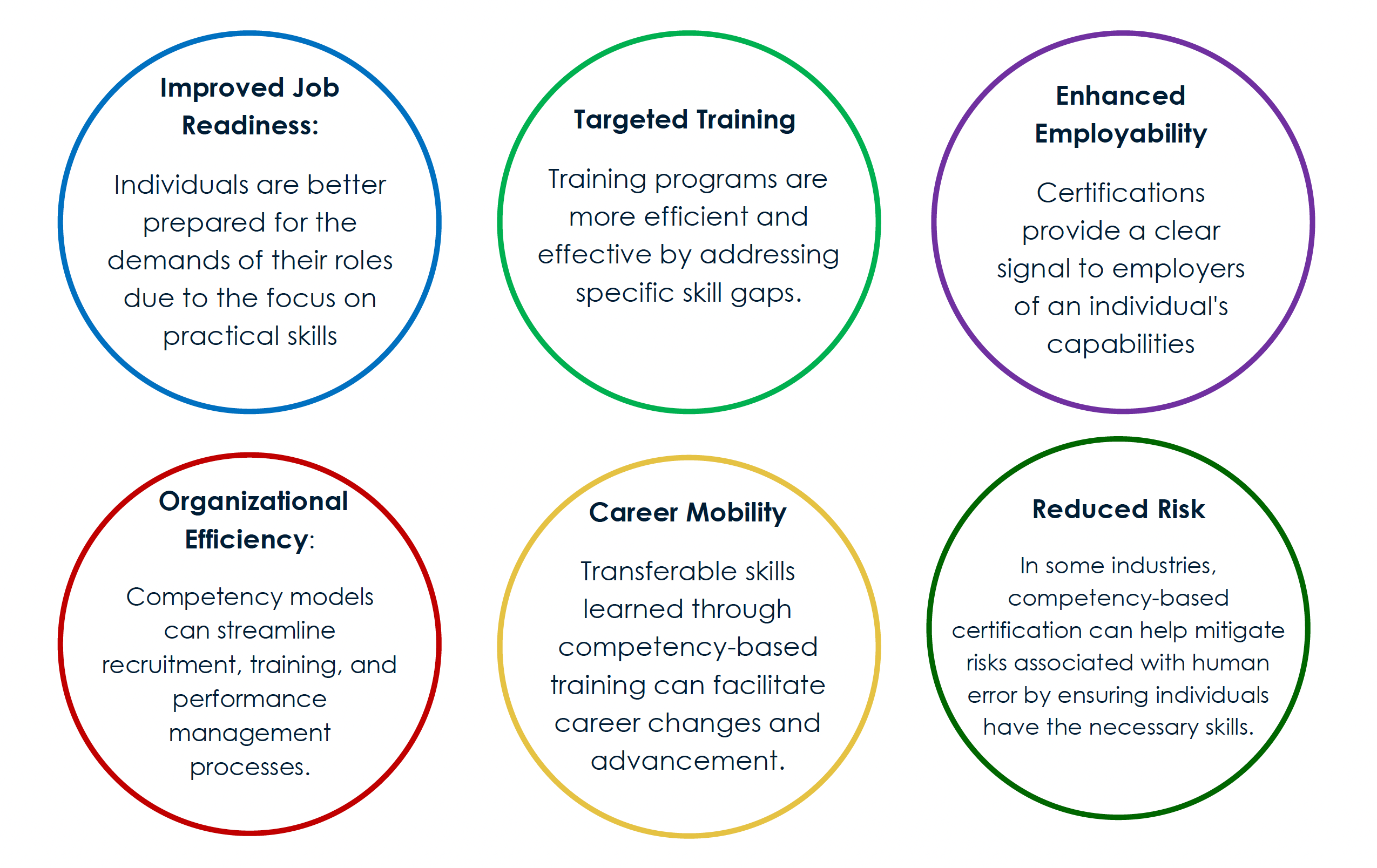
Quality anchors are commonly referred to as accredited certifications and recognition schemes that verify the technical competency and reliability of products, processes, or services, ensuring they meet high standards of quality and performance.

Accreditation
An accreditation is a review process to determine if an educational or training programs meet the defined standards of quality. Once achieved, an accreditation is not deemed permanent; it is renewed periodically to ensure that the quality of the educational or training program is maintained.
It is a formal and independent verification that endorses that a program or institution meets established quality standards and is competent to carry out specific conformity assessment tasks. Conformity assessment tasks may include, but are not limited to, testing, inspection, or certification.
Accreditation has been used for over 50 years as the definitive means of evaluating organizations and is now utilized by all the world’s major economies and many developing economies.
To ensure global credibility, the following are key factors:
i. People certifications should be operated by bodies conforming to ISO/IEC 17024 (person certification). (ISO)
ISO/IEC 17024 is an international standard that outlines the general requirements for bodies that operate personnel certification programs. It sets the criteria for organizations that certify individuals against specific requirements, ensuring their operations are fair, impartial, credible and globally recognised. It thereby enhances confidence for employers and the public in the competence of certified individuals.
In Malaysia, CIDB Malaysia has achieved ISO/IEC 17024 accreditation and operates certification programs based on the standard for various technical certifications
Globally, the Institute for Credentialing Excellence (ICE) partnered with the International Service (IAS) to offer members of the National Commission for Certifying Agencies (NCCA), an autonomous body of the Institute for Credentialing Excellence (ICE), to evaluate professional certification programs against rigorous standards. Certification bodies are accredited to ensure that they adhere to this internationally accepted standard, ensuring that assessment processes are fair, repeatable, and defensible.
National Commission for Certifying Agencies (NCCA)
The National Commission for Certifying Agencies (NCCA), an autonomous body of the Institute for Credentialing Excellence (ICE), evaluates professional certification programs against rigorous standards to ensure professional competence.
The NCCA’s Standards for the Accreditation of Certification Programs were the first standards developed by the credentialing industry for professional
certification programs. NCCA was founded as a commission whose mission is to help ensure the health, welfare, and safety of the public through the accreditation of a variety of certification programs that assess professional competence.
NCCA Process
NCCA accreditation signifies that a certification program has met the NCCA’s stringent, industry-recognized standards. It assures the public and the profession that the program has a valid and reliable process for development, implementation, and maintenance.
The NCCA standards are consistent with The Standards for Educational and Psychological Testing (AERA, APA, & NCME, 1999) and are applicable to all professions and industries. Accreditation for professional or personnel certification programs provides impartial, third-party validation that your program has met recognized national and international credentialing industry standards for development, implementation, and maintenance of certification programs.
To date, NCCA has accredited more than 315 programs from more than 130 organizations.
ii. Management system certifications (organizational) should align with ISO/IEC 17021(ISO)
ISO/IEC 17021 is a standard for bodies that audit and certify management systems, such as ISO 9001 (quality) or ISO 14001 (environmental). It is a
widely recognised framework for assessing the competence of certification bodies offering management systems certification.
The current version is ISO/IEC 17021-1:2015, which sets requirements to ensure certification bodies are competent, consistent, and impartial in their processes. This standard helps build trust and acceptance of management system certifications internationally by ensuring a high level of quality and integrity from certification bodies.
The standard is applicable to the audit and certification of any type of management system, not just quality or environmental systems.
Part 1 (ISO/IEC 17021-1:2015): This is the primary part of the standard, containing the generic requirements for all management system certification.
In terms of benefits, adherence to ISO/IEC 17021 builds confidence among stakeholders, enhances the credibility of certified management systems, and facilitates the international recognition and acceptance of certifications.
iii. Product /service schemes with ISO/IEC 17065. (ISO)
ISO/IEC 17065 is an international standard that outlines the requirements for organizations that certify products, processes, and services. It establishes criteria for certification bodies to operate competently, consistently, and impartially, which is essential for building trust and confidence in their certification activities among clients, regulators, and the public.
The standard is a key part of conformity assessment, ensuring that products, processes, and services meet specified requirements.
As far as Third-Party Certification, it sets the requirements for independent organizations (certification bodies) that provide a third-party declaration of conformity, assuring stakeholders that the certified entity meets certain standards
In terms of benefits, it provides an internationally recognized benchmark for certification bodies, enhancing their reputation and fostering trust among stakeholders. Accreditation to ISO/IEC 17065 signifies a commitment to globally recognized best practices, facilitating mutual recognition and reducing barriers to trade. It is also inevitable that complying with the standard encourages enhanced efficiency, effectiveness, and improved management systems within accredited organizations.
Accreditation bodies should be globally recognised so certificates are accepted across borders, reducing duplicate assessments and boosting employer trust.
In practice, there are other accreditation bodies such as ANAB, A2LA, IAS, JAS-ANZ, UKAS, and others that operate these programs regionally, but it may not be recognised in all countries within a specific region. (ANAB, A2LA, IAS Online, JASANZ)
Integrating RPEL/APEL to Widen Access
APEL stands for Accreditation of Prior Experiential Learning, a Malaysian system under the Malaysian Qualifications Agency (MQA) that offers an alternative pathway to higher education by recognizing an individual’s existing knowledge, skills, and attitudes gained through experience.
Accreditation of Prior Experiential Learning (APEL) is a systematic process that involves the identification, documentation and evaluation of learning based on prior experience. APEL allows people to gain admission to academic programs via APEL.A or to receive credit for courses via APEL.C without possessing the required traditional academic qualifications, fostering lifelong learning and career development. APEL pathways also include APEL.M for micro-credentials and APEL.Q for qualifications. These processes provide a structured mechanism to map experiential evidence to standards while protecting assessment integrity.
Recognition of Prior Experiential Learning (RPEL)
RPEL stands for Recognition of Prior Experiential Learning, a process and program where an individual’s practical, work-based, or life experience is assessed and recognized as equivalent to formal academic learning, potentially for gaining academic credit or skills certification. It allows individuals to demonstrate their existing knowledge and competencies, often through a portfolio or reflective account, to gain entry to a program, receive academic credit, or be certified in a specific skill without necessarily having followed a traditional educational path.

High-quality certification systems should recognize prior learning to expand opportunity without diluting standards. Malaysia’s RPEL (under HRD Corp) and the Malaysian Qualifications Agency’s APEL pathways can be referred by Certification bodies when defining eligibility, equivalency, and alternative routes to the exam. (HRD Corp, MQA)

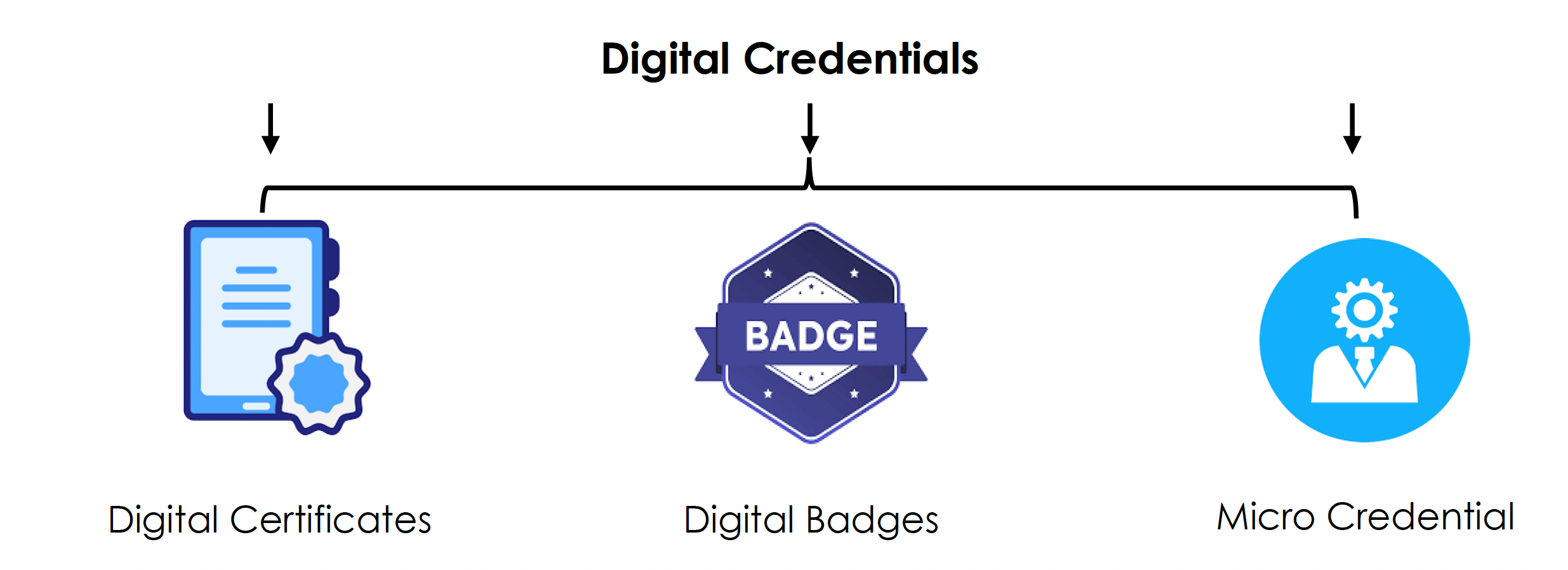
Digital credentials are digital certificates or documents that are given by a party to prove someone’s qualification, claim, or achievement. Digital credentials are often a digital version of what we normally get as physical documents, such as an association membership certificate, passport, NRIC, driver’s license, and university degree.
Digital credentials are simple to provide, manage, and verify. Some credentials may contain personal information such as someone’s birthplace, name, birth date, or biometric information like a fingerprint.
Key elements of digital credentials include the following:
Digital Certificates
A digital certificate is a type of electronic credential that can prove the authenticity of a person, device, server, or website. In learning programs, compared to digital badges, digital certificates are awarded as digital credentials for achievements that take longer, like a university degree or a two-year certification program.
Anything that can be issued as a physical certificate can be done as a digital certificate, including:
Digital certificate authentication helps organizations ensure that only trusted devices and users can connect to their networks. Another common use of digital certificates is to confirm the authenticity of a website to a web browser, which is also known as a Secure Sockets Layer or SSL certificate.
A digital certificate contains identifiable information, such as a user’s name, company, or department and a device’s Internet Protocol (IP) address or serial number. Digital certificates contain a copy of a public key from the certificate holder, which needs to be matched to a corresponding private key to verify it is real. A public key certificate is issued by certificate authorities (CAs), which sign certificates to verify the identity of the requesting device or user.
Benefits of digital certification
Digital certificates can be requested by individuals, organizations, and websites. To do so, they provide the information to be validated and a public key through a certificate signing request. The information is validated by a publicly trusted CA, which signs it with a key that provides a chain of trust to the certificate.
This enables the certificate to be used to prove the authenticity of a document, for client authentication, or to provide proof of a website’s credentials.
Different types of Digital Certification
There are three different types of public key certificates: a Transport Layer Security (TLS)/SSL certificate, a code signing certificate, and a client certificate.
1. TLS/SSL certificate
A TLS/SSL certificate sits on a server – such as an application, mail, or web server- to ensure communication with its clients is private and encrypted. The certificate provides authentication for the server to send and receive encrypted messages to clients.
The existence of a TLS/SSL certificate is signified by the Hypertext Transfer Protocol Secure (HTTPS) designation at the start of a Uniform Resource Locator (URL) or web address. It comes in three forms:
i. Domain-validated
A domain-validated certificate is a quick validation method that is acceptable for any website. It is cheap to obtain and can be issued in a matter of minutes.
ii. Organization validated
This provides light business authentication and is ideal for organizations selling products online through e-commerce.
iii. Extended validation
This offers full business authentication, which is required by larger organizations or any business dealing with highly sensitive information. It is typically used by businesses in the financial industry and offers the highest level of authentication, security, and trust.
2. Code signing certificate
A code signing certificate is used to confirm the authenticity of software or files downloaded from the internet. The developer or publisher signs the software to confirm that it is genuine to users who download it. This is useful for software providers that make their programs available on third-party sites to prove that files have not been tampered with.
3. Client certificate
A client certificate is a digital ID that identifies an individual user to another user or machine, or one machine to another. A common example of this is email, where a sender signs a communication digitally and its signature is verified by the recipient. Client certificates can also be used to help users access protected databases.
Digital Badges
The purpose of digital badges is to recognize skills gained in less formal settings outside of traditional education systems. Digital badges are usually used for credentials that take a short time to learn, like completing a project or a workshop. Digital badges look like a physical medal and are issued by a variety of organizations, including training providers, non-profits, companies, and colleges. They can represent simple participation in a workshop to competency-based learning.
Digital badges can be verifiable digital credentials that contain:
Key aspects of digital badges include shapes, colors, and symbols that can be utilised to identify levels of achievement. Badges can be designed so they can be easily embedded and shared across a variety of platforms like social media, email signature, online portfolio, and resume.
A Digital badge can be awarded for:
Digital Badging Platform
A digital badging platform is software used to issue, send and manage digital badges online. It allows organizations to award badges to learners or employees to recognize skills and achievements.
Top platforms connect directly to your existing tools, like learning management systems or customer success software.
With a reliable digital credential platform, you save time and give your badge recipients a smooth process from start to finish.
Successful digital badging platforms/programs
Micro Credential
A micro-credential is a certification of skills and competencies acquired through a short, focused course or training program. Unlike a traditional degree that takes years, a micro-credential can be completed in a much shorter period, often just weeks or months, and targets specific, in-demand skills. Upon completion, learners typically receive a digital certificate or badge that can be verified by employers and other institutions.
Micro-credentials confirm when someone achieves the learning outcomes of a short course, webinar, or module. Micro-certificates can be added to someone’s record throughout their professional career. People can present micro-certificates during job interviews or use them for professional development within an organization.
Key Information about micro-credentials includes the following:
Benefits of Micro-credentials
Micro-credentials can improve a person’s employability and help them stand out in a competitive job market by showcasing targeted expertise. They also bridge gaps in skills.
With rapid changes in technology and the job market, micro-credentials also offer a way to quickly acquire new skills to stay relevant.
Micro-credentials are also cost and time-efficient. Compared to multi-year degree programs, micro-credentials require a smaller financial and time investment.
Micro-credentials support lifelong learning by making it easy and affordable for professionals to continuously update their skills
Providers of Micro-credentials
Micro-credentials are offered by a variety of institutions, often in collaboration with industry leaders to ensure the curriculum meets real-world demands. Providers include:
Verifiable Credentials
Verification in digital credentials confirms the authenticity and legitimacy of digital claims about a person, organization, or asset. It uses cryptographic signatures and secure ecosystems to create tamper-proof, instantly verifiable credentials, moving away from slow, manual verification processes. This process gives the credential holder control over their data, deciding what information to share and with whom.
Verifiable Credentials can be checked instantly and at much lower costs, which saves organizations a lot of money, resources, and time.
The main difference between the older versions of digital credentials and verifiable digital credentials is that people can instantly verify if they are authentic or not by simply scanning a QR code.
To sum up, as credentials become more granular and portable, the ecosystem is converging on Open Badges (now stewarded by 1EdTech) and on verifiable credential models. The above-mentioned digital badging platforms enhance security, verifiability, and interoperability, enabling stackable credentials that carry structured metadata (issuer, criteria, alignment to frameworks, evidence). Certification schemes like Credly can issue both a digital certificate or badge (for signalling) and a verifiable certificate (for compliance and audits). (imsglobal.org).
For tamper-evident records, early implementations (e.g., MIT’s Blockcerts) show how blockchain can back credential integrity and learner ownership—useful where international verification is frequent. The specific technology is optional, but the verifiability principle is increasingly non-negotiable. (MIT Registrar, Blockcerts)
Global certification practices involve globally recognized standards and frameworks that validate an individual’s or organization’s competence and adherence to specific requirements in various fields.
These practices are essential for:
i. International Recognition
Global certifications are recognized across borders, enabling professionals to work in diverse international settings and with multinational companies.
ii. Framework and Standards
Many fields rely on established frameworks and standards like the International Professional Practices Framework (IPPF) for internal audit, which provides a globally recognized structure for internal audit functions.
iii. Professional Development
Certifications validate an individual’s skills and knowledge, contributing to their professional development and career progression.
iv. Quality Assurance
Certifications help ensure consistent quality and adherence to best practices within a specific industry or field.
v. Market Access
In some sectors, such as technology, certifications can be crucial for market access, as certain clients or projects may require proof of certification.
HRCI, a global HR Certification Body
HRCI’s portfolio illustrates many of the above principles discussed on Certification.
Recognized globally as the gold standard of accredited HR certifications, HRCI, an independent non-profit organization is accredited by the National Commission for Certifying Agencies (NCCA). HRCI is the only global HR certification body to be accredited globally. Seven out of its eight programs have been accredited. Accreditation offers imperial, third-party validation that the development and administration of our certification programs has met stringent standards set by the testing industry.
HRCI is also the only organization appointed as the international HR Secretariat, serving as the administrative chair to provide organizational certifications under the ISO umbrella of standards. This makes HRCI the only global HR certification body to offer individual and organization certifications.
HRCI operates with more defensible job/practice analyses, a published an HR Capability Model™ connecting knowledge, stakeholder-relevant capabilities, and outcome domains, and explicit recertification requirements.
In Malaysia, HRCI offers their global HR Certification programs as a part of a Dual HR certification program with NHRC, offering the best of two worlds, i.e. global HR practises and Malaysian local labour and business legislations. The program demonstrates how stacked credentials can combine international standards with domestic governance and compliance, improving portability without losing national specificity. (Credentialing Excellence, HRCI Marketing)
A robust certification program system is a structured framework that provides assurance of quality, integrity, and compliance through independent assessment, adherence to international standards, continuous monitoring, and a commitment to transparency and improvement. Key components include having clear governance and independence, adherence to standards & job analysis, quality assessment, delivery identity, data analytics, recertification and recognition and portability.
i. Governance & independence
ii. Standards & job analysis
iii.Assessment quality
iv. Delivery & identity
v. Recertification
vi. Data & analytics
vii. Recognition & portability
i. Define Certification programs vs training products.
Publish a national definition that distinguishes training courses (instructional hours, completion) from certifications (independent assessment against standards). Training programs with titles ‘Certified’ must be clearly reviewed and vetted based on the required components of a certification program.
HRD Corp guidelines (e.g., HRD-TDF 2025) and scheme documents should codify evidentiary requirements for exam quality, independence, and renewal. (HRD Corp)
ii. Require defensible job analyses.
For funded certification schemes, it is paramount that evidence of a current job/practice analysis, blueprint, and standard-setting documentation per NCCA and Testing Standards. (Credentialing Excellence, AERA)
iii. Incentivize accreditation and MLA recognition.
Encourage person-certification bodies to align with ISO/IEC 17024 and seek accreditation by global accreditation bodies, e.g., Institute for Credentialing Excellence (ICE), International Accreditation Service (IAS), to improve global portability of Malaysian-issued credentials. (ISO)
iv. Expand access via RPEL/APEL.
Utilise RPEL and APEL as structured on-ramps for non-traditional learners (especially experienced workers without formal qualifications), with clear mapping to certification eligibility. (HRD Corp, MQA)
v. Digitize credential verification.
Adopt one of the digital credential platforms, like Credly or Open Badges 3.0, and verifiable credentials for all publicly supported certifications to enable instant employer verification and fraud reduction. (1edtech.org)
vi. Publish outcomes.
Mandate annual transparency (number tested, pass rates, time-to-credential, employment outcomes, recertification rates) for funded certifications.
The roadmap will be based on 5 phases and for a defined period of 12 months, and will include SMART KPIs, funding and incentives, risk management and roles & management.
1. Five (5) Phase Roadmap
Phase 1: Mobilize (Month 0-2)
Phase 2: Design (Month 2-5)
Phase 3: Build (Month 5-8)
Phase 4: Assure (Month 8-10)
Phase 5: Launch & Accredit (Month 10-12)
2. Key Performance Indicators (KPIs)
In certain functions where the awareness is still low on being professionally certified, we may need to increase awareness in candidates e.g. in HR on why they need to raise the bar of HR competency and possess a globally recognised professional certificate holder in HR.
Access & equity
Quality & rigor
Relevance & outcomes
Portability & recognition
3. Integrity & trust
4. Risk Management and Mitigation
AS IS Certification Programs in Malaysian Case Studies (illustrative)
HRCI, a global HR Certification body, teams up with NHRC, a division of HRDCorp, to offer ‘World’s No 1 Dual HR Certification’ offering the best of both worlds, i.e. global HR best practices and Malaysian labour law and related laws, credentials. These programs ensure both portability and national compliance-an approach already proven locally. (NHRC and HRCI Marketing). Credentials, i.e. digital certificates and badges, can be verified on Credly by Pearson Vue (Credly).
5. Roles and responsibilities
Certification that counts is not about hours of instruction or certificate programs; it is about a credible, validated demonstration of competence that employers recognize and trust. By anchoring Malaysian programs to ISO/IEC and NCCA standards, widening access via RPEL/APEL, and adopting verifiable digital credentials, HTLs can build a relevant certification market that delivers for workers, firms, and the economy- at
home and across borders. As the borders are blurring, it is pertinent that the certifications are globally recognised to ensure employability and also acceptable for the gig community.
The framework and roadmap above translate policy intent into operational steps and measurable outcomes, ensuring that every ringgit invested in skills turns into productivity, mobility, and resilience for Malaysia’s workforce. (ISO, Credentialing Excellence, HRD Corp, 1edtech.org)
Source presentation: HRD Corp Thought Leaders Braintrust No. 1/2025 – “Certification That Counts” (slides).
Prepared for HRD Corp Thought Leaders (HTLs) and sector partners to guide the design and governance of certification systems that matter to employers and Malaysians.
